Introducing MicroCF: understanding the timing of conversation
Our Conversation Flow release combines VAD and VAP for end-of-turn and interruption detection, with public results on TurnBench.
 Simplex AI Research & engineering
A conversation is more than a sequence of answers
A useful voice agent needs to respond at the right moment and make room when a person takes the floor. Today we introduce MicroCF, our Conversation Flow system for two parts of that timing problem: end-of-turn detection (EOT) and interruption detection (INT).
MicroCF is part of our work on Interaction Models. The release brings together the project write-up and a public TurnBench model entry, submitted under SPX-AI (Simplex AI) on September 13, 2026.
Current activity and what may happen next
Voice activity detection, or VAD, describes whether speech is present. A pause alone, however, does not tell us that a person has finished their thought. Voice activity projection, or VAP, estimates upcoming speaker activity from audio already observed.
MicroCF combines these signals to decide when a turn has ended and when another speaker is taking over. EOT and INT maintain separate temporal states and operating points. Events are emitted when their confirmation conditions hold; they are not backdated to the start of a pause.
Public TurnBench test results
On the public model page, captured September 21, 2026, MicroCF reports:
| Task | Recall | False-positive rate | Median detection latency | Recall rank |
|---|---|---|---|---|
| End-of-turn | 90.6% | 7.9% | 678 ms | 3 of 20 |
| Interruption | 98.4% | 7.3% | 747 ms | 1 of 18 |
These are the model page’s held-out test figures. Its ranking uses recall; rank alone does not summarize false triggers or latency. The snapshot may change as the leaderboard receives new submissions.
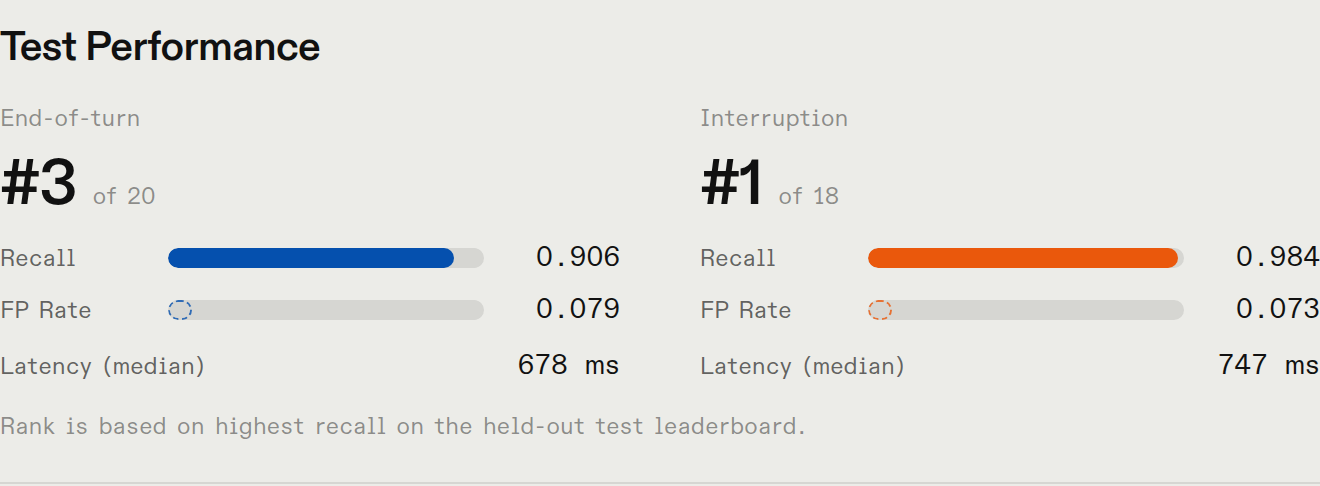
Source: TurnBench — SPX-AI MicroCF. Screenshot captured September 21, 2026. This panel reports test performance.
Development results, shown separately
The project reports evaluation across 38 development conversations, about 7.31 hours of audio. EOT reached 90.13% recall, 10.16% FPR, and 681.5 ms median delay. INT reached 98.56% recall, 7.05% FPR, and 771 ms median delay. The TurnBench charts below display rounded development values.
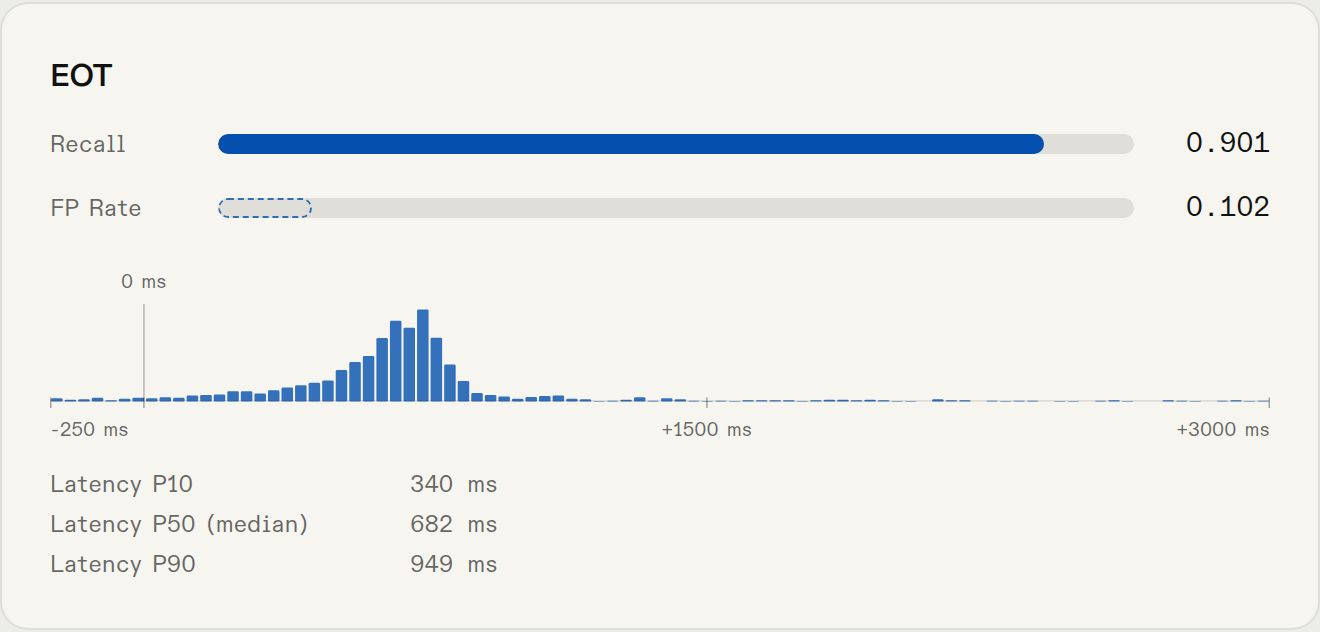
TurnBench development EOT panel, captured September 21, 2026. These are development-set measurements, separate from the test table above.
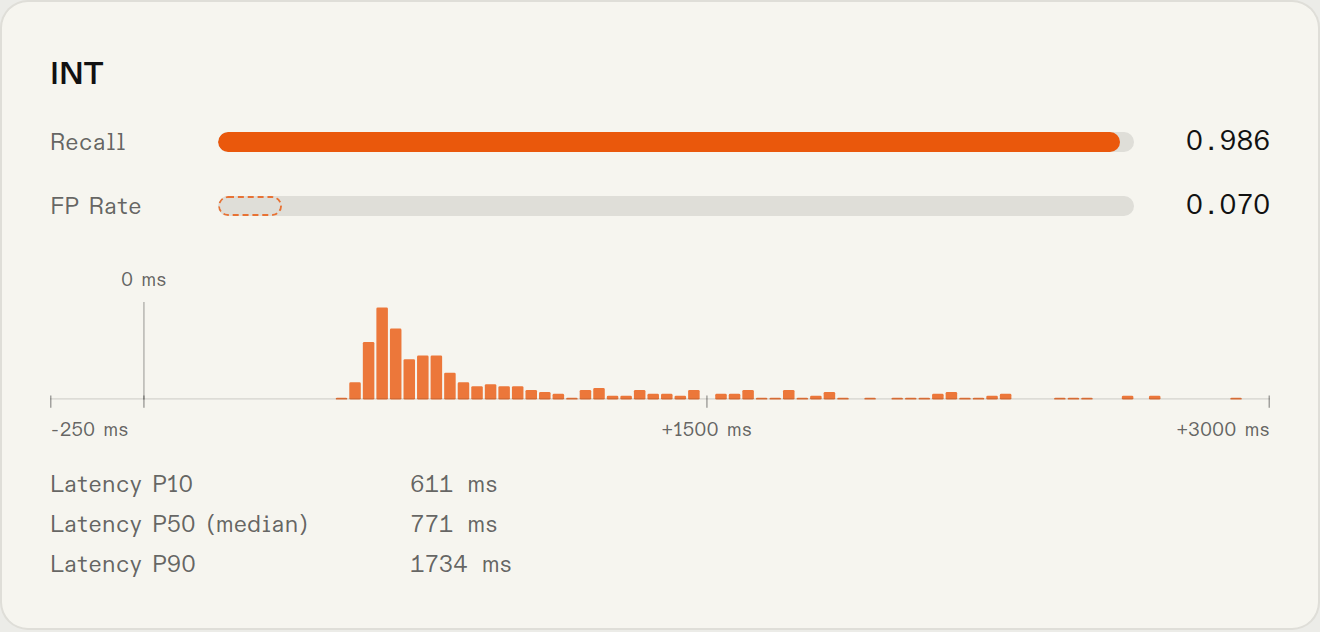
TurnBench development INT panel, captured September 21, 2026. The latency distribution helps put its median in context.
Development data was used to select operating points. Previously inspected internal validation subsets are not presented as untouched holdouts. The project’s development delay measures the required audio horizon and excludes inference and transport overhead; it should not be read as complete application response time.
Building toward natural interaction
MicroCF focuses on conversational timing. It does not replace speech recognition, speech generation or the model that decides what to say. It contributes a specific part of the interaction: when to begin responding and when to yield.
The project also describes MacroCF as future work on context-aware conversation flow. That direction is separate from the evaluated MicroCF release and its results.
Read the MicroCF project page for the policy and evaluation details, or explore the TurnBench model page for the current public results and per-conversation development analysis.